

 News
News 
- By WalkThru Media
- 08 Aug, 2026
Trakheesi permit rules apply to virtual tours because the Dubai Land Department treats a virtual tour of a listed property as an advertisement, in the same way it treats a photograph or a portal listing. If the property is being marketed, the tour needs a permit number and that number needs to be visible. This is the part brokers most often miss, because a tour feels like a viewing tool rather than an advert.
Why a tour counts as an advertisement
The distinction that matters is not the format, it is the purpose. A photograph on Bayut is an advertisement. A video walkthrough on Instagram is an advertisement. A 360 tour of the same unit, hosted on a link and sent to a buyer on WhatsApp, is doing the same job: it is promoting a specific property that is for sale or for lease. Regulators have consistently read it that way, and the fact that the tour lives on a third-party viewer rather than a portal does not change what it is being used for.
The practical consequence is that the tour cannot be treated as an internal sales asset. Once it is shared outside your office, it is advertising, and it carries the same obligations as any other advertisement for that unit.
Where the permit number has to appear
The requirement is that the permit number travels with the advertisement. For a photograph on a portal, the portal handles the placement. For a virtual tour, nothing handles it for you, because the tour is a self-contained environment that opens in its own window with no listing page around it.
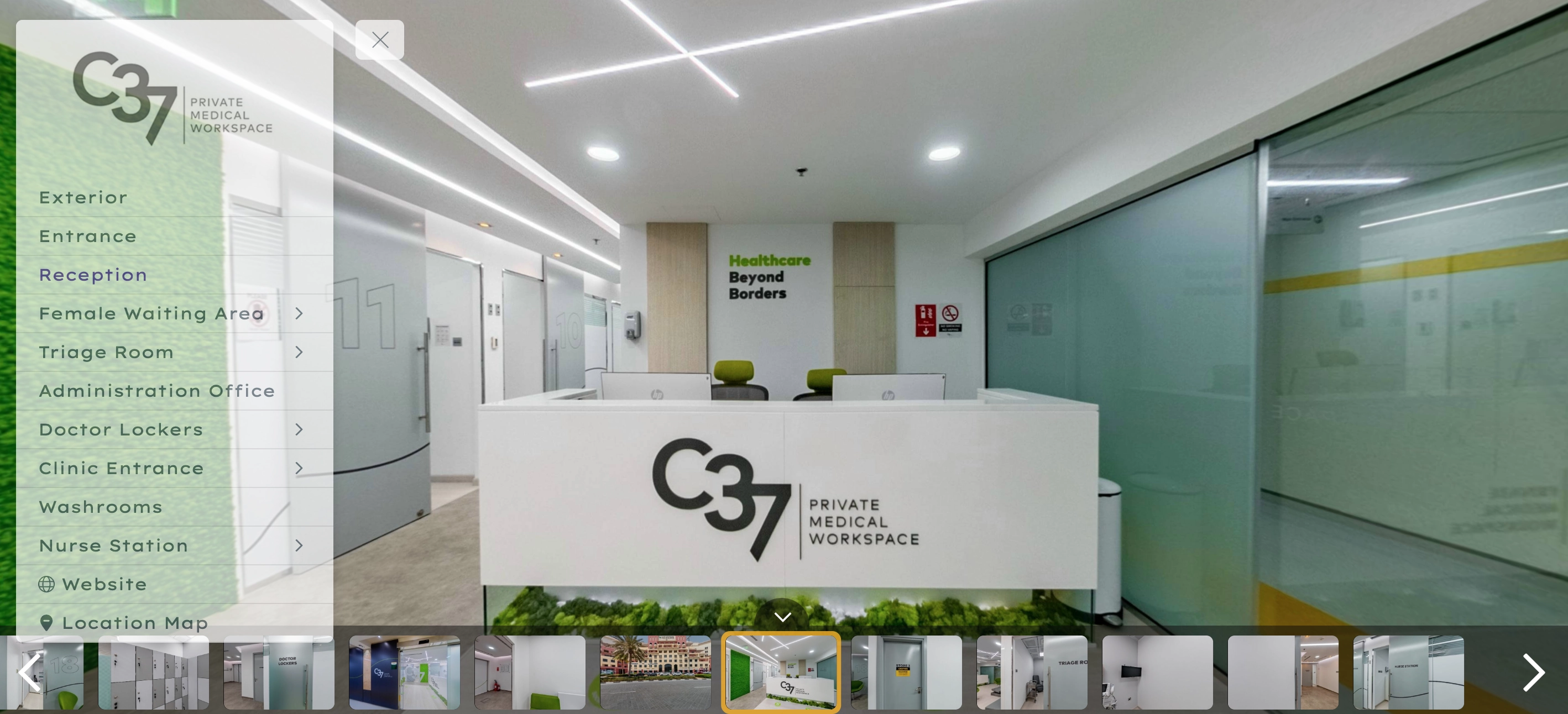
That means the number has to be inside the tour itself. In practice there are two places it works: on the opening splash screen, so it is visible before anyone starts navigating, and as a persistent overlay in a corner of the interface, so it stays visible as the viewer moves between rooms. A corner overlay is the more robust of the two, because a viewer who is sent a direct link to a specific scene never sees the splash screen at all.
What does not work is putting the number only on the page that embeds the tour. Tours get shared as bare links, forwarded, and embedded on other sites. The moment the tour leaves the page you built for it, any compliance text on that page is gone.
Getting the placement right without ruining the tour
Compliance text and usable navigation compete for the same screen space, especially on a phone. An overlay pinned to the bottom-right corner of the frame usually sits clear of the navigation controls most viewers put at the bottom-centre and the fullscreen control at the top-right. It needs to be legible against both a dark hallway and a bright, white-walled living room, which usually means a semi-transparent backing rather than plain text.
It also needs to survive the viewer's own responsive behaviour. A tour interface that reflows on a narrow screen can push a corner element off-frame or under a control. This is worth checking on an actual phone before the tour is published, not in a desktop browser window resized to look like one.
What to confirm before you publish
Check that the unit has a current permit and that the number you are about to embed is the one issued for this listing, not one carried over from a previous campaign. Check that the number appears in the tour and not only on the page around it. Check it on a phone. And check what happens when someone opens a direct link to an interior scene rather than the tour entrance.
Fees, penalties and processing times are set by the Dubai Land Department and change from time to time. Rather than quote figures that may be out of date by the time you read this, confirm the current position directly with the DLD through the official Dubai Land Department channels or through your brokerage's compliance team before you rely on it.
How this affects the way a tour is built
None of this is difficult, but it is much easier to handle when the tour is produced than to retrofit afterwards. When we build a 360 virtual tour for a listed property, the permit number is added to the interface as part of production, so the tour is compliant the moment it is delivered and stays compliant wherever it is shared. Retrofitting means re-exporting and re-sharing a link that may already be circulating.
Tours outlive the listings they were made for
A permit is tied to a marketing campaign for a specific property, and campaigns end. The tour does not. It stays on the hosting platform, the link keeps working, and it keeps circulating in WhatsApp threads and old emails long after the unit has been sold or let.
That creates a situation worth thinking about in advance. A tour still carrying a permit number that has since expired is advertising a property that is no longer available, under a permit that no longer applies. The tidy answer is to decide at production what happens to the tour when the campaign ends: taken down, or kept as a portfolio piece with the listing-specific compliance text removed and the unit anonymised.
The same applies when a unit is relisted. A relisting is a new campaign with a new permit, so a tour reused from the previous campaign needs its number updated rather than inherited.
Multiple units and show apartments
Developments raise a separate question. A tour of a show apartment used to market many units is not a tour of one specific listing, and a tour presented as a particular unit when it is actually a different unit of the same type is a misrepresentation regardless of permits.
The safe practice is to be explicit in the tour itself about what the viewer is looking at. If it is a show unit or a representative layout rather than the exact apartment being sold, say so inside the tour, where the buyer sees it, rather than in a caption that will not travel with the link.
The same reasoning applies to listings across every community we cover, from Dubai Marina to Business Bay. The obligation follows the property, not the postcode.